


Internationaal Europees en buitenlands recht
Resultaat 97–108 van de 1531 resultaten wordt getoond
 Rechtbank Noord-Holland 20 september 2013, nr.
 Blijft de Koning onschendbaar?
C.A.J.M. Kortmann
Conseil constitutionnel 22 januari 1999, Journal officiel 24 januari 1999, p. 1317, 98-408 DC De volgende vijf kwesties komen in dit arrest aan de orde. 1 Het stelsel van constitutionele rechtspraak in Frankrijk; 2 De toetsingsnormen inzake verdragen; 3 Misdrijven van ambtsdragers; 4 Amnestie en verjaring; 5 Hoe zit dit alles in Nederland. Zie de volledige uitspraak: https://www.conseil-constitutionnel.fr/en/decision/1999/98408DC.htm
Annotaties en wetgeving | Annotatie
oktober 1999
AA19990760
 Het Amerikaanse chemieconcern 3M werd in België veroordeeld wegens bovenmatige burenhinder door het veroorzaken van verontreiniging met forever chemicals. Deze bijdrage bespreekt het Belgische recht over bovenmatige burenhinder. Ook voor Nederlandse juristen kan deze uitspraak relevant zijn. De PFASverontreiniging heeft zich ook naar Nederland verspreid. Het Belgische recht kan daarbij mogelijk rechtstreeks relevant zijn op basis van het internationale privaatrecht. Indirect kan het een inspiratiebron zijn voor Nederlandse vorderingen.
 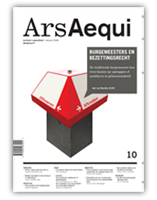 De Duitse razzia’s onder Nederlandse niet-joodse jongeren begin februari 1943 waren een schending van het bezettingsrecht – het Landoorlogreglement (LOR) – en leidden tot een eerste vorm van collectief burgemeestersverzet tegen de bezetter. Vanaf midden 1942 was de Duitse bezetter echter reeds begonnen met het deporteren van de Nederlandse joden, eveneens een evidente schending van het LOR. Dit artikel gaat in op de vraag waarom een dergelijk collectief protest en beroep op het LOR van de burgemeesters uitbleef toen hun joodse stadgenoten opgepakt werden ter deportatie.
  The EDF case is of key importance for European state aid analysis in general and for the application of the so-called market investor principle in particular. In a modern economy the State assumes a variety of roles such as tax authority, shareholder, ultimate guarantor that certain public services are provided. The state also acts as quasi-financial or investment institution as a regulator of economic and social activity. Generally, state aid analysis is only concerned with the effects of a state measure – not the form of the measure nor indeed the overall objective of state intervention in the economy. The EDF case is important because it clarifies the relationship between the key concepts of form and effects in State aid analysis and gives guidance to the Commission on the type of analysis that needs to be performed on State measures, such as tax measures used to pursue certain objectives, before concluding that they can be considered ‘State aid’ within the meaning of Article 107(1) TFEU. This article argues that the EDF ruling injects a welcome dose of realism into State aid analysis at a time in which it is arguably becoming more difficult to pin down which of its many hats the State is wearing.
  Het lijkt alsof centralisatie van patiëntgegevens nationaal en Europees een onvermijdelijke trend is. Betoogd wordt hoe deze trend omgebogen kan worden en waarom dit gewenst is. Vanuit juridisch perspectief vergt dit onder meer een radicale omslag via gegevensbescherming-by-design, actualisering van de dertig jaar oude Wet op de geneeskundige behandelovereenkomst en het gebruik maken van de mogelijkheden in de nog te formuleren uitvoeringswetgeving voor de European Health Data Space.
 Resultaat 97–108 van de 1531 resultaten wordt getoond